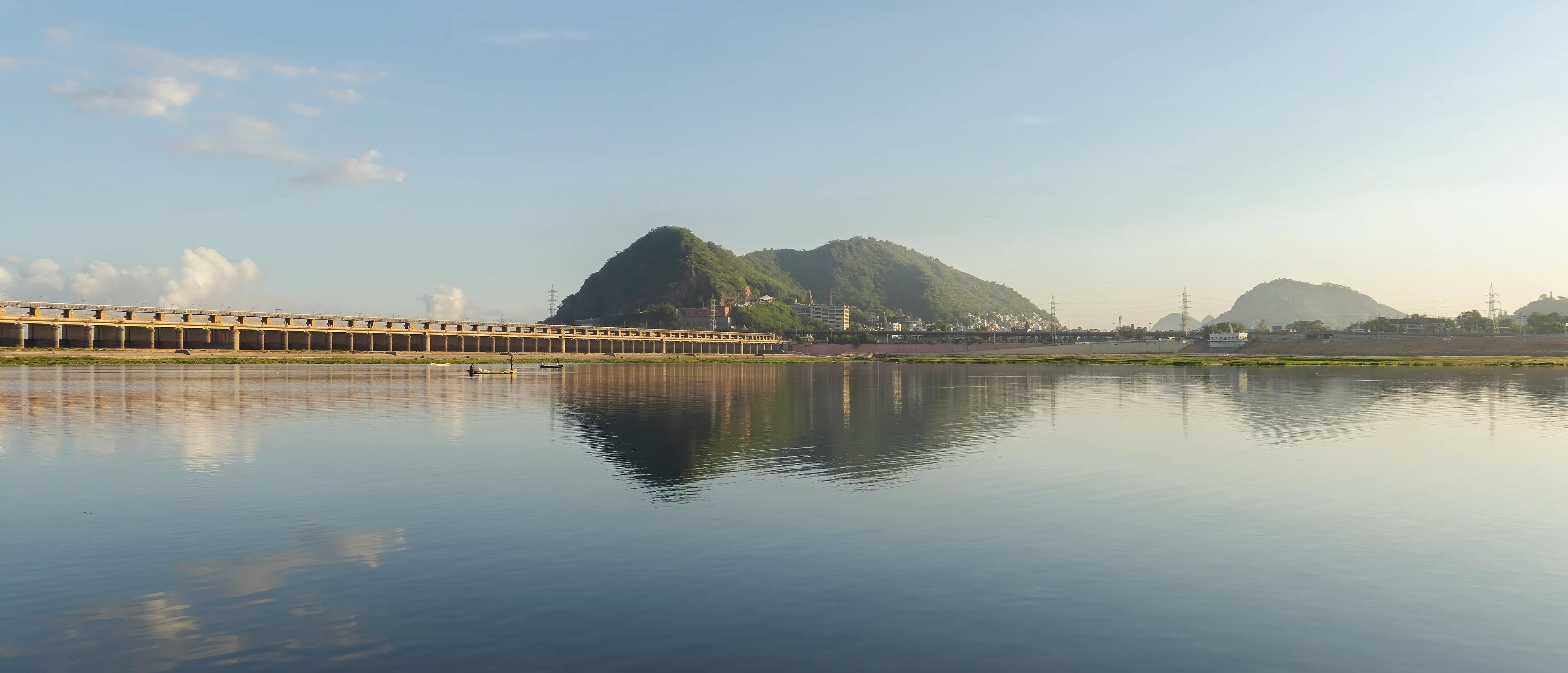
This guide is for the traveller who wants more than a checklist and for the new resident trying to make sense of the city. It explains how Vijayawada is laid out, what each part of town is for, and which practical details are worth checking before you arrive.
Where Vijayawada sits
Vijayawada lies on the northern bank of the Krishna in south-central Andhra Pradesh. The river forms the city’s southern edge; across it lie Guntur district and the planned capital region around Amaravati. The city is the headquarters of NTR district, which was formed from part of the former Krishna district in 2022.
That geography explains a lot about how the city works. The Krishna is not a decorative backdrop: it supplies water, divides the road network and creates the riverfront that residents use for evening walks. The barrage, the ghats and the islands are all part of everyday infrastructure as well as visitor attractions.
Vijayawada district: NTR and the former Krishna district
Vijayawada is the headquarters of NTR district. The district administration explains that NTR district is named after Nandamuri Taraka Rama Rao and that its headquarters is Vijayawada, formerly called Bezawada.
NTR is the current district name; it is not another name for Hyderabad. In 2022, the former Krishna district was divided into Krishna and NTR districts. Some older addresses, maps and local references still use “Krishna district”, so both terms can appear in practical paperwork.
For current administrative information, use the NTR District profile and the Krishna District profile.
How the city is organised
Vijayawada is not a single grid. It grew around several centres, and locals navigate by junction, neighbourhood and landmark rather than by street number. For a visitor, these are the areas that matter most:
| Area | What it is useful for | What to expect |
|---|---|---|
| Benz Circle and MG Road | Commercial core, shopping, restaurants, hotels | Dense traffic, bright signage and the most visitor services |
| Governorpet and Labbipet | Central business and dining addresses | Busy streets; useful for a short stay with a car or cab |
| One Town | Old commercial quarters, wholesale markets, everyday city life | Crowded, chaotic and best explored on foot with patience |
| Patamata and Gunadala | Residential neighbourhoods east of the centre | Quieter evenings; fewer sights within walking distance |
| Bhavanipuram | North-western river side, temple access | Mixed residential and arterial roads; check exact hotel access |
| Gollapudi and Gannavaram road | Airport access | Edge-of-city feel; limited sightseeing on foot |
| Across the Krishna | Amaravati, Undavalli and southern-bank destinations | A separate trip; river crossings can be slow at peak times |
Area descriptions are editorial orientation, not ratings. Confirm the exact address and approach for any booking.
History in brief
The city was long known as Bezawada, a name still used in railway and business contexts. Its position on the Krishna made it a crossing point and a trading centre, and the arrival of the railway in the nineteenth century strengthened its role as a junction between coastal Andhra, the Deccan and the south.
The twentieth century brought the barrage, industrial growth and a rapid expansion of education and healthcare. Today Vijayawada is a commercial and service centre as well as a pilgrimage stop. The layers are visible: the old market streets, the temple hill, the mid-century river infrastructure and the new apartment towers on the edges.
For deeper history, use the official district and temple sources listed at the end of this page. We avoid repeating popular origin stories as fact when they cannot be checked.
Culture and festivals
Telugu is the language of the city, and the cultural calendar is closely tied to the temple and the agricultural year. Dasara, when the Kanaka Durga Temple draws large crowds, is the most visible festival for visitors. Sankranti in January and Ugadi, the Telugu new year, are also widely observed. Dates follow the lunar calendar, so check the year you are travelling.
Food is central to local identity. Andhra meals, with rice, pappu, vegetable curries, pickles and curd, are the everyday reference point; biryani, tiffin and seafood also have devoted followings. Our restaurants guide explains the food landscape without publishing unverified rankings.
The city also has a strong cinema and shopping culture, a book festival tradition and a busy calendar of religious and civic events. Ask at your hotel or check local news for the week you are in town; recurring events can change dates.
What is Vijayawada famous for?
Vijayawada is known for the Kanaka Durga Temple on Indrakeeladri, the Krishna riverfront around Prakasam Barrage and Bhavani Island, Andhra meals and tiffin, and its role as a railway and road junction for the region. Across the river, Amaravati is the planned capital region.
These are different kinds of places: the temple is an active place of worship, the barrage is working infrastructure, and the island is a river recreation area. Check current access before visiting. Start with the places to visit guide, the temple guide or the restaurants guide.
Economy and working life
Vijayawada’s economy is broad rather than dependent on one sector. Trade and distribution, education, healthcare, hospitality, transport and professional services all have a presence. The city’s position between the coast and the interior, and its rail and road links, make it a natural base for businesses serving Andhra Pradesh.
For newcomers, the practical point is that work is spread across the centre and the edges, and commuting by road is the norm. If you are moving for a job, agree on the office location before choosing a neighbourhood. Our living guide covers housing, utilities and settling-in questions.
Getting your bearings
Most arrivals come through Vijayawada Junction (BZA), Pandit Nehru Bus Station (PNBS) or Vijayawada International Airport at Gannavaram. The station and PNBS are close to the central city; the airport is east of town and requires a road transfer.
- For a first city visit, use the central commercial area as your base and take cabs or buses to individual sights.
- For an early flight, consider a hotel on the airport road rather than crossing the city at dawn.
- For the temple, plan around crowd patterns rather than trying to fit it between two other appointments.
- For Amaravati or Undavalli, treat the river crossing as a separate half-day, not a quick add-on.
Read the travel guide for a full planning sequence, or go straight to the airport guide and local transport guide.
What this guide does — and does not — claim
We publish practical information only when we can trace it to a source we trust, and we tell you when something needs checking. Opening hours, ticket prices, bus numbers and hotel rates change frequently; we link to the operator instead of freezing a number that may be wrong next month.
We do not publish paid rankings, invented reviews or scraped business data. Sponsored placements, when they exist, are labelled. Read our editorial policy for the full process.
Frequently asked questions
Is Vijayawada the same as Amaravati?
No. Vijayawada is an established city on the northern bank of the Krishna and the headquarters of NTR district. Amaravati is the planned capital region on the southern side of the river. They are separate places with separate administration.
Which district is Vijayawada in?
Vijayawada is in NTR district, Andhra Pradesh. The district was formed from part of the former Krishna district in 2022; some older addresses and maps still refer to Krishna district.
Is Vijayawada in Hyderabad?
No. Vijayawada is a city in Andhra Pradesh, on the Krishna River, and the headquarters of NTR district. Hyderabad is a separate city in Telangana. They are different places in different states.
What language is spoken in Vijayawada?
Telugu is the main language. English is widely used in hotels, offices and larger restaurants, but learning a few Telugu greetings will make everyday interactions easier.
How many days do I need in Vijayawada?
Two full days cover the temple, the riverfront and one heritage excursion at a comfortable pace. Three days allow a day trip towards Amaravati or Kondapalli and a slower food and market day.
Sources and further reading
- NTR District Administration — About District Official district profile; district name, headquarters and the former name of Vijayawada
- Krishna District Administration — About District Official district profile; records the 2022 division into Krishna and NTR districts
- OpenStreetMap — Vijayawada Base mapping and coordinates, retrieved 25 Nov 2026
- Airports Authority of India — Vijayawada Airport Official airport operator page
- APSRTC — Andhra Pradesh State Road Transport Corporation Official state bus operator
- NTR District — Kanaka Durga Temple Official district tourism page